

Showing posts with label Multiplication. Show all posts
Showing posts with label Multiplication. Show all posts
Thursday, October 25, 2018

Wednesday, January 24, 2018
Xtra Math
Last night while I was perusing my list of 3rd Grade math and science blogs, I came upon a post from 3rd Grade Thoughts. She wrote about an online Math program that focuses on math facts! It's called Xtra Math and it's FREE! I set up a teacher account this evening and have played around in it a bit before setting up all of our kiddos. They each have their own PIN number (which I will send home either this week or next week) and are set up to start working on multiplication facts! If you would like to start working before I send everyone's paper home, send me an email and I will pass along your child's login info.
After logging in, a Placement Quiz opens for your child to be assessed and see what facts need to be practiced.
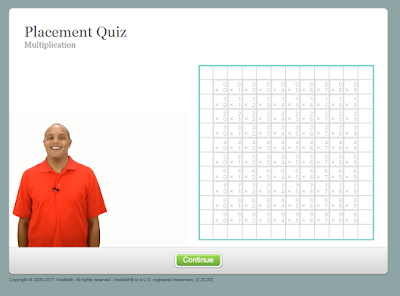


After logging in, a Placement Quiz opens for your child to be assessed and see what facts need to be practiced.

Throughout the placement quiz (and later during the practices), a timer at the bottom of the screen moves along to tell you if you are answering questions quickly, taking a little extra time, or letting time slip away.

If the answer is correct, a new fact pops up.

If the answer is incorrect or if too long is taken, the answer shows grayed out. A blue hour glass also comes onto the screen if too long has passed before the question is being answered.

To try and match the speed of our timed test, the smiley face on the timer is set to 3 seconds, which is very close to the average amount of time needed to spend on a problem to answer all questions on our timed tests.
If your child gets to school early enough in the mornings {by 7:30} on Tuesday, Wednesday or Thursday I can stop by the gym and grab them so they can work on Xtra Math on the computers in the room.
Hopefully, this resource is one that you are able to use at home!

Partial Product Finder
Last week, we started taking a more in depth look at multiplying by 2 digit numbers and what the distributive property looks like. We have been focusing on breaking our 2 digit numbers up by their place values and having a group for the tens place and a group for the ones place.
Jennie Kottmeier has some really good {and FREE} properties of multiplication posters that you can get {here}. This is what the distributive property looks like.
Last night, as I was searching the web for math fact practices, I came across a web app through Math Learning Center. They have so many great {FREE} apps that can be used on the computer as a web app or on a tablet as a downloadable app!
Their newest app that they are still in the process of building is a {drum roll, please!} partial product app! You can change the factors in the problem and move the arrows at the side of the array to change the distribution of numbers in the problem.


 It also tells you the new multiplication equation for each section of the array, what the partial products for each section are, and the total after all of the partial products are added together. This is EXACTLY on of the strategies we have been working on!
They have several other free math apps that can be used on the web or downloaded onto a tablet. Number Pieces and Number Line are some good apps for practicing different operations. Check out their other math apps {here}.

Jennie Kottmeier has some really good {and FREE} properties of multiplication posters that you can get {here}. This is what the distributive property looks like.
 |
| 7 is broken up into 5 and 2. Then, 5 is multiplied by 4 and 2 is multiplied by 4. 5x4=20 and 2x4=8. 20 and 8 are the partial products that area added together to get 28. |
Last night, as I was searching the web for math fact practices, I came across a web app through Math Learning Center. They have so many great {FREE} apps that can be used on the computer as a web app or on a tablet as a downloadable app!
Their newest app that they are still in the process of building is a {drum roll, please!} partial product app! You can change the factors in the problem and move the arrows at the side of the array to change the distribution of numbers in the problem.


They have several other free math apps that can be used on the web or downloaded onto a tablet. Number Pieces and Number Line are some good apps for practicing different operations. Check out their other math apps {here}.
I hope you find this resource useful! :)

Wednesday, January 17, 2018
2 Digit Multiplication
This week we started multiplying 1 digit numbers by 2 digit numbers. The method we have been focusing on this week is called Break Apart. We are using prior knowledge of place value, distributive property, addition (sometimes with regrouping) and 1 digit multiplication to solve our multiplication problems with this method.


When we are using the break apart model, we are breaking our 2 digit number apart into the tens place and the ones place. We are then multiplying the tens place by the first factor and finding that product, then multiplying the ones place by the first factor and finding that product. Once we have the product for both sets, we are taking those 2 numbers (our partial products) and adding them together to find our whole product. I promise it's not as confusing to work out as it is to read!
 |
| The answer, after adding the partial products 150 + 18 would be 168 |
{Here} is the link to a quick video of me working out one of the problems we did in class this week. It is also on the step-by-step page that was sent home with week along with the guided practice as extra practice as needed. {The video is an *.avi file, which may not play on some players. I am working on converting it to *.mp4 and compressing it so it will upload directly to this post.}
We have not talked about this in class yet, but it very similar to the break apart we have been doing (just without the blocks!)

In the area model, we are again breaking up our factors into their place value groups, multiplying each group in each factor by each other, then adding the totals together. This can be used with factors that go beyond 1 digit and 2 digits multiplication.
 |
| The answer after adding the partial products 150 +18 would be 168 |
 |
| The answer, after adding the partial products 45,000 + 900 + 180 and + 27 would be 46,737 |
 |
| This is a long one! The answer, after adding the partial products 70,000 + 8,000 + 0 + 60 + 14,000 + 1,600 + 0 + 12 would be 93,672 |
Multiplication Models
Below are some different models to help with multiplication practice at home. Most of these are models that we have used with single digit multiplication in class or tutorials. These models can be used for double digit multiplication as well, but it tends to be a bit more difficult when there are so many numbers!
There is also a copy of this file linked through Google Drive if you would like to download it or print it out to use during at home practice time! Click {here} for the file with each picture per page and {here} for each model explanation and example per page.


There is also a copy of this file linked through Google Drive if you would like to download it or print it out to use during at home practice time! Click {here} for the file with each picture per page and {here} for each model explanation and example per page.


Subscribe to:
Posts (Atom)